How to Build a More Self-Reliant Property Without Going Fully Off-Grid
Answer-first summary
Most people do not need to go fully off-grid to become more resilient. A stronger and more realistic goal is a property that works normally on the grid but can keep water, power, food, and daily life functioning when something breaks. That usually means adding backup layers over time instead of trying to disappear from modern systems all at once.
Resilience is not the same thing as disappearing
When people hear “off-grid,” they often imagine a remote cabin, constant labor, and a life built around managing every system by hand.
That is one path. It is not the only useful one.
For most land buyers, a better goal is a property that stays connected to ordinary life but is less fragile when ordinary life stops cooperating. That means the grid can still be your default while backup systems carry you through outages, storms, supply disruptions, or rising utility costs.
The strongest setup is usually layered
A self-reliant property does not start with perfection. It starts with a few systems that reduce your dependence on a single point of failure.
That can mean:
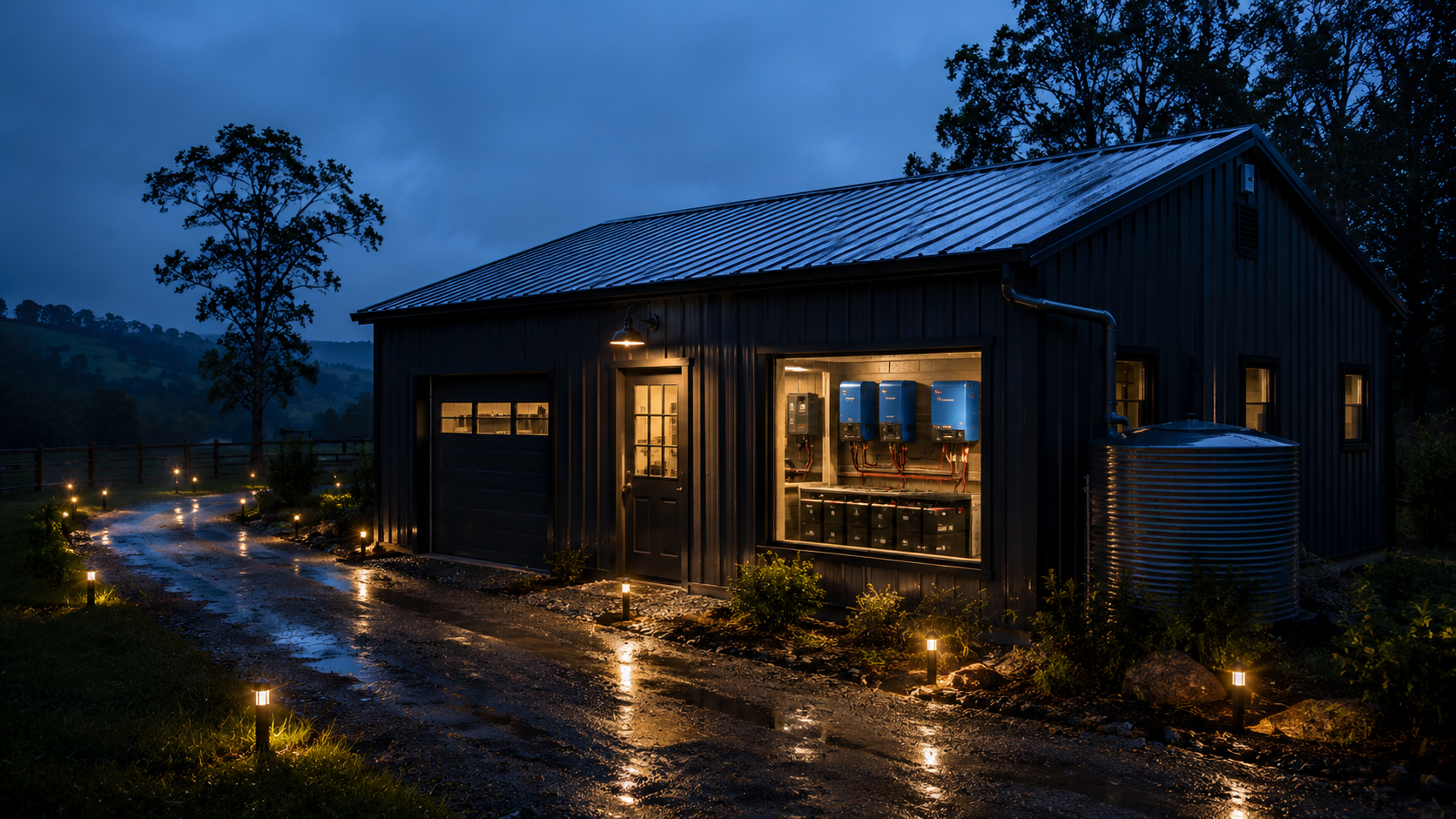
- backup power for the essential circuits,
- stored water and a realistic water plan,
- a food-growing area that actually gets used,
- heating or cooling options that do not depend on one machine,
- and enough pantry depth to stop reacting like every outage is a crisis.
Ready.gov’s power outage guidance is a useful reminder that most household resilience starts with basic continuity, not fantasy infrastructure.
Grid-tied can still be resilient
Staying connected to the grid does not mean you are unprepared. In many cases, it is the most practical baseline.
The real question is whether you can keep the important parts of life moving if the grid fails for a few days or longer. That is where smaller battery systems, generators, stored food, water treatment, and compartmentalized energy use start to matter.
If the grid works, great. If it does not, the property should have a backup mode.
Water is usually harder than power
People tend to think about batteries first because power is visible. Water is usually the more serious issue.
If your water depends on a well pump, filtration, pressure, or electricity, then your water system and power system are tied together. EPA’s Homeowner’s Guide to Septic Systems (PDF) also makes the point that wastewater is part of the same resilience picture. A property does not become self-reliant just because it has panels on the roof.
Food resilience starts smaller than people think
You do not need to grow every calorie you eat. A more realistic place to start is:
- staples you actually use,
- a garden you can maintain,
- a way to preserve part of the harvest,
- and enough pantry depth that you are not living trip to trip.
That is why How to Grow More of Your Own Food and How to Build a Homestead in Phases fit this conversation so well. Resilience is usually built through repeatable habits, not dramatic leaps.
Practical takeaway
The LandShop version of self-reliance is not bunker logic. It is a calmer idea:
Keep the systems you already use, then add enough redundancy that one outage does not own you.
That is what makes a property more self-reliant without forcing it into full-time off-grid life.
Want help thinking through a grid-tied resilience setup for your property? Sign up for LandShop and ask questions in the community. You can compare backup systems, land layouts, and phased plans before you spend money in the wrong order.
Sources and further reading
FAQ
Do I have to go fully off-grid to become more self-reliant?
No. For most people, a grid-tied property with backup layers is a more practical and sustainable path than full off-grid living.
What should come first: power, water, or food?
Usually the answer is not one thing alone. You want enough power to support critical systems, enough water to stay functional, and a food plan that reduces fragility over time.
Is this kind of setup only realistic on large acreage?
No. Many of the most useful resilience steps can happen on modest acreage or even in suburban settings before someone ever buys larger land.
More questions in this topic
Ask LandShop
Need help applying this to a real parcel?
Bring your actual land, financing, tax, zoning, or build question into the LandShop community and pressure-test the plan before you commit.