How a Land Wholesaling Deal Actually Works
Answer-first summary
A land wholesaling deal works when an operator controls a parcel at a price that still leaves room for a real end buyer, then assigns or closes and resells that deal cleanly. In practice, the job is not just finding a cheap seller. It is matching the right parcel to the right buyer, understanding the land well enough to price it honestly, and getting the paperwork to closing without pretending title, access, utilities, or zoning are optional details.
Land wholesaling is simpler than house wholesaling in some ways, but it is not magic
That is part of why people are drawn to it.
There are no tenants, no repair bids, and often no need to physically walk every parcel just to know whether the basic deal makes sense.
But the clean version of the model only works when three things line up:
- the seller is actually motivated,
- the parcel actually fits a known buyer profile,
- and the numbers are still real after basic land due diligence.
The simplest version of the model
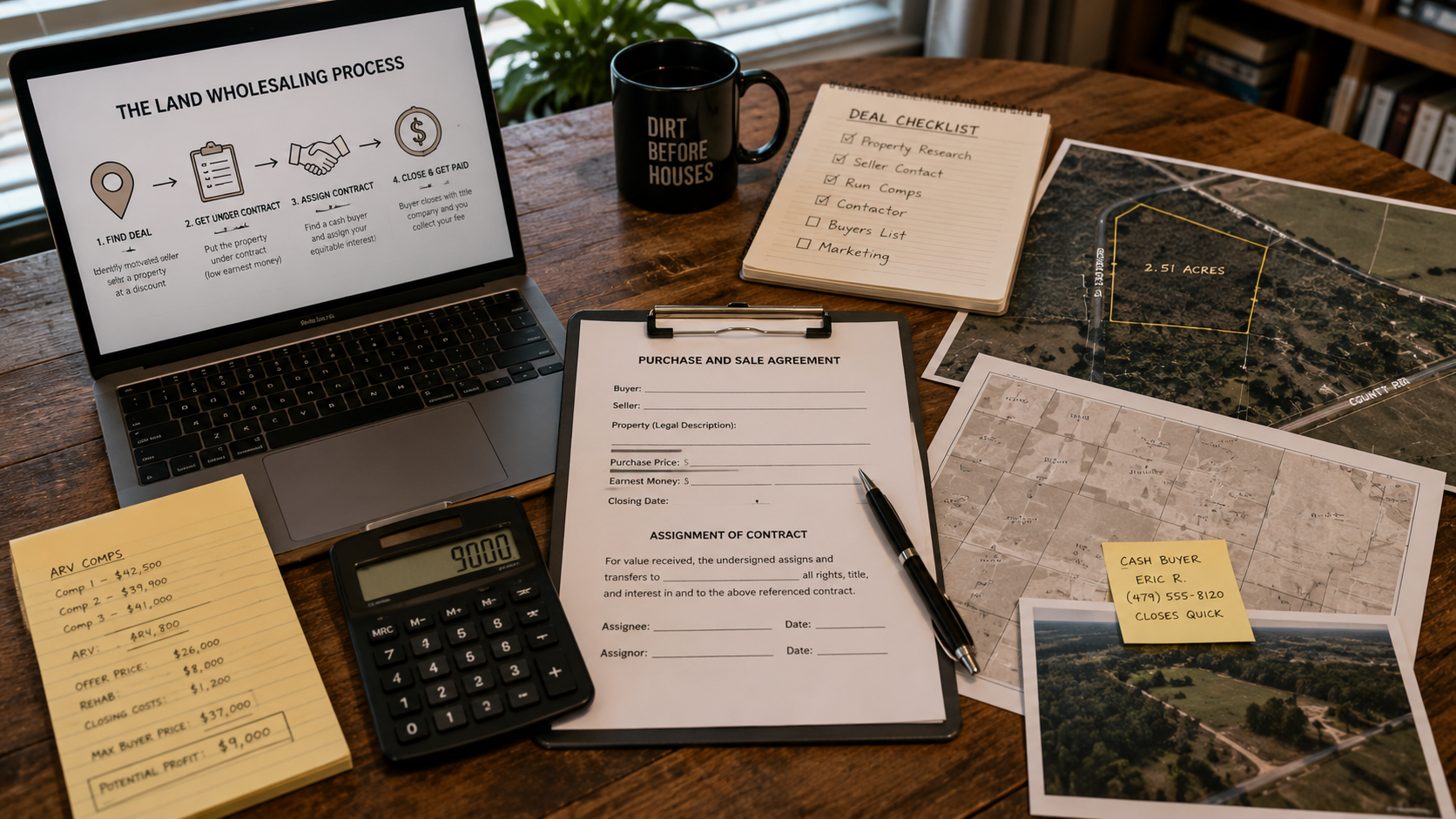
At its core, land wholesaling usually means:
- finding a parcel you can control below the price an end buyer will pay,
- getting that parcel under contract,
- then assigning the contract or double closing with the real buyer.
That is the high-level version. The real work is everything that has to happen between step one and step three.
Good wholesalers usually know the buyer side first
One of the strongest ideas in the transcript is the “buyer first” concept.
That part is real.
If you already know what kinds of parcels builders, small developers, or land investors will actually buy, you stop wasting time on land that looks cheap but does not fit anyone’s real buy box.
That is the practical version of reverse wholesaling: understand the likely buyer before you get emotionally attached to the parcel.
Seller lead generation is only useful if the land fits the market
The transcript talks heavily about pulling motivated-seller lists and reaching out at scale.
That can produce leads, but leads are not deals.
A lead becomes interesting only when the parcel fits the kind of land buyers in that market are already taking down.
That is why strong operators do not just ask, “Will the seller take less?”
They also ask:
- is this an infill lot or a more speculative rural tract,
- is there real road access,
- what is the utility picture,
- is the terrain workable,
- is it in a flood or wetlands problem area,
- and what zoning or use path is actually available?
Underwriting still matters, even when the buyer is known
The transcript makes a useful point and then pushes it a little too far.
Yes, knowing what the buyer will pay can simplify the offer.
No, that does not mean you can skip underwriting.
Even if a buyer has a strong buy box, the operator still needs to understand:
- legal access,
- flood risk,
- wetlands,
- zoning,
- utility availability,
- slope,
- and comparable sales.
Otherwise the whole spread is resting on assumptions.
That is exactly why pieces like What Land Buyers Learn Too Late and How to Think About Water, Septic, and Driveway Costs Before You Buy belong next to this topic.
Assignment is the mechanics, not the business model
Once the seller contract is signed and the buyer is lined up, the wholesaler usually either:
- assigns the contract for a fee,
- or closes and resells through a double-close structure if the deal or buyer requires it.
That is the easy part to describe and the hard part to do consistently if the rest of the deal is weak.
A title company that understands investor transactions matters. So do clean paperwork and realistic expectations around the spread.
But none of that rescues a parcel that was never a fit for the buyer in the first place.
Practical takeaway
The real land-wholesaling skill is not blasting lists or talking fast on the phone.
It is learning how to connect four things cleanly:
- motivated sellers,
- parcels that actually fit demand,
- pricing that leaves room for a real spread,
- and closings that do not depend on confusion.
That is why land wholesaling can work very well, and also why a lot of people mistake activity for actual deal flow.
Related questions
- What Land Wholesaling Actually Is
- Wholesaling vs Flipping vs Brokering Land
- How to Wholesale Land Without Burning Your Reputation
- Land Business Hub
Want help pressure-testing whether a land deal is actually wholesaleable before you chase it? Ask LandShop.
Sources and further reading
FAQ
What is the simplest definition of land wholesaling?
It usually means getting a parcel under contract at a price that leaves room for an end buyer, then assigning the contract or closing and reselling it cleanly.
Why does knowing the buyer first help so much?
Because it keeps the operator from wasting time on parcels that may look cheap but do not fit what active buyers in that market actually want.
Can you skip due diligence if the buyer already has a buy box?
No. Access, flood risk, wetlands, zoning, utilities, and other parcel realities still matter because they determine whether the deal actually performs the way the spread assumes it will.
More questions in this topic
Related links
Ask LandShop
Need help applying this to a real parcel?
Bring your actual land, financing, tax, zoning, or build question into the LandShop community and pressure-test the plan before you commit.