Why Local Processing Capacity Matters More Than People Think
Answer-first summary
Many communities do not mainly have a production shortage. They have a processing shortage. Small farms can often grow or raise food, but they still need kitchens, slaughter access, cold storage, packing space, and regional infrastructure that fits their scale. Without those middle layers, local food stays scarce, expensive, and fragile even when nearby land could produce much more.
Food does not move from field to table by magic
One of the easiest mistakes in local-food conversations is assuming the main challenge is production.
Sometimes it is.
But often the bigger problem is what happens after the food is grown, raised, or harvested.
That middle layer includes things like:
- slaughter and processing,
- commercial kitchens,
- packing and washing space,
- cold storage,
- freezer storage,
- and short-haul distribution.
If those systems are missing, local food has a hard ceiling no matter how much nearby land could produce.
Local food needs middle infrastructure, not just more enthusiasm
People often imagine two ends of the equation:
- the farm,
- and the customer.
But the missing piece is often the infrastructure in between.
Without it:
- animals may have nowhere practical to be processed,
- value-added food ideas never become legal or affordable to produce,
- produce loses quality before it reaches buyers,
- and seasonal abundance cannot be held long enough to stabilize supply.
This is one reason local food can feel inconsistent. It is not always because the farm failed. It is because the local system around the farm is too thin.
Small processing gaps create large market gaps
The thinner the local processing layer, the more likely a farm is to face impossible choices:
- sell raw and low-margin,
- drive long distances,
- reduce production,
- overbuild prematurely,
- or abandon the product idea altogether.
That hurts both sides.
Farmers lose revenue opportunities.
Buyers lose reliable access.
The community loses one more piece of regional food resilience.
This is where scale matters again
A lot of processing infrastructure has been shaped for bigger operators.
That means small producers frequently need something lighter:
- shared kitchens,
- regional cold rooms,
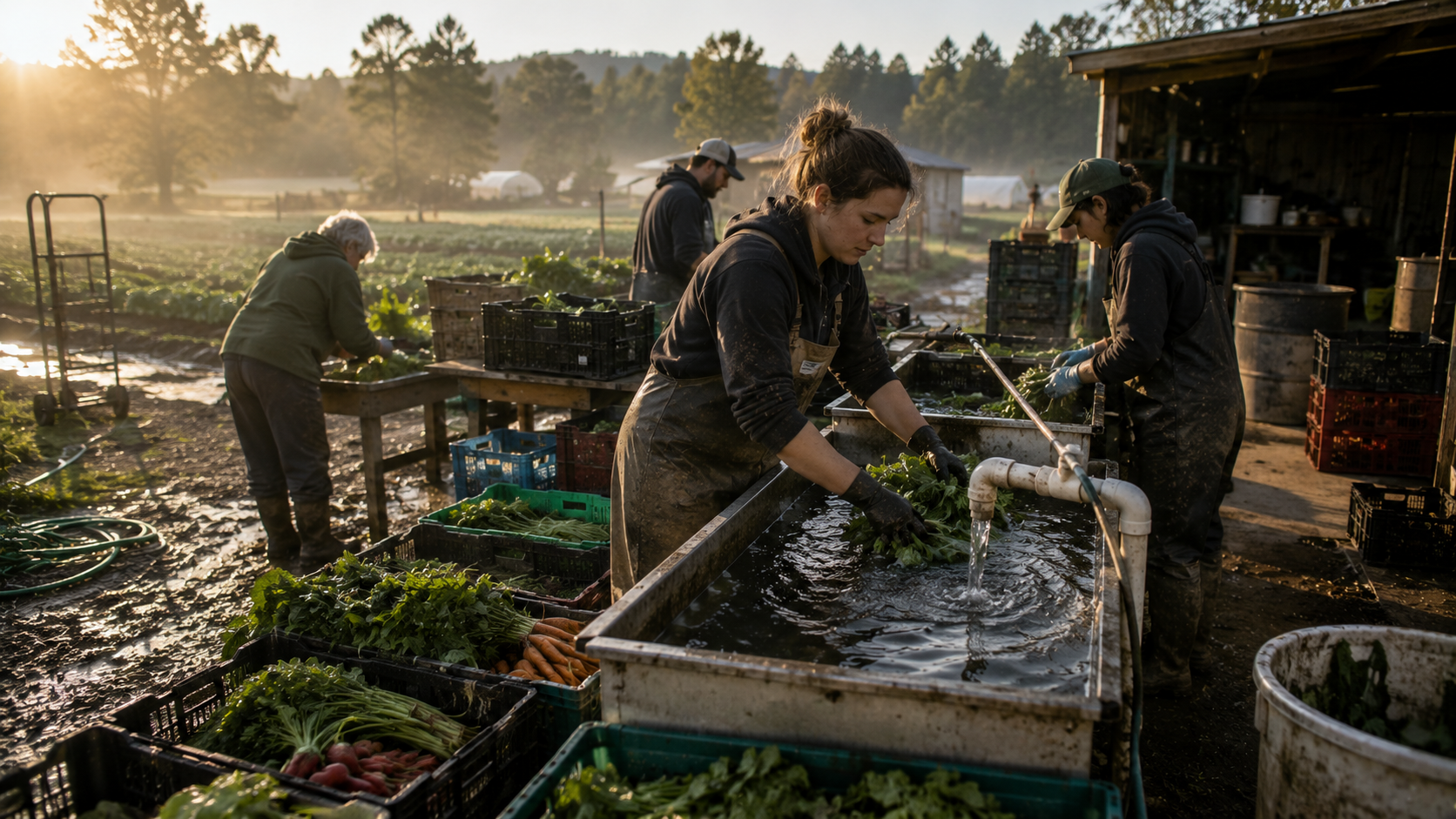
- practical wash/pack spaces,
- local freezer capacity,
- mobile or small-scale processing,
- and legal ways to aggregate local production without forcing it into industrial cost structures.
The absence of those options creates an invisible barrier. From the outside, it looks like local food just is not there. In reality, the missing link is often the middle layer that would have made selling possible.
Why this matters for land viability
This is a land issue because processing capacity changes whether productive acreage can support an actual business.
A small operator may be able to raise poultry, vegetables, dairy, fruit, or pantry ingredients on limited acreage.
But if the region offers no workable path to:
- prepare,
- process,
- store,
- or distribute that product,
then the land can only support a much thinner economic use.
That is one reason some rural places still have land and farming know-how but less useful local food than they should.
The missing infrastructure turns land potential into stranded effort.
Communities should think about food infrastructure the way they think about roads
Roads matter because they connect people and goods.
Food infrastructure matters for the same reason.
A region with:
- small processors,
- local kitchens,
- cold storage,
- and simple aggregation points
gives nearby land a way to become economically useful.
A region without those things forces small producers into long trips, higher spoilage, lower margins, and weaker buyer relationships.
That is not just a farm problem. It is a civic and regional capacity problem.
Practical takeaway
If local food feels scarce, expensive, or inconsistent, the missing piece may not be more producers. It may be more local processing capacity.
Communities that want better local food need more than gardens and good intentions. They need middle infrastructure that matches small-farm scale and keeps more value close to the land.
Related reading
FAQ
What is local processing capacity?
It includes the kitchens, slaughter access, wash-pack space, cold storage, freezer storage, and small-scale infrastructure needed to move food from production into usable local sales.
Why does local food stay expensive when farms are nearby?
Because missing middle infrastructure forces small producers into higher costs, longer travel, more spoilage risk, or lower-margin selling paths.
Why is processing capacity a land issue?
Because land can only support local food enterprise if there is a practical way to process, store, and move what the land produces.
More questions in this topic
Related links
Ask LandShop
Need help applying this to a real parcel?
Bring your actual land, financing, tax, zoning, or build question into the LandShop community and pressure-test the plan before you commit.