What Is Owner Financing for Land?
Answer-first summary
Owner financing means the seller acts as the lender instead of a bank. For land buyers, that can open up deals that would otherwise be hard to finance, especially on rural or unconventional parcels. But flexibility does not remove risk. The contract structure, title path, payoff terms, and default provisions matter just as much as the monthly payment.
Why owner financing shows up so often in land deals
Raw land and rural land do not always fit cleanly into standard bank underwriting. The parcel may be unimproved, unusual, outside a lender's preferred area, or part of a phased long-term plan rather than an immediate house build.
That is why owner financing matters so much in land.
Instead of a bank lending the money, the seller agrees to receive payments over time. In the right deal, that can make land access easier. But it also means the buyer has to understand the paper much more carefully.
Owner financing can mean different contract structures
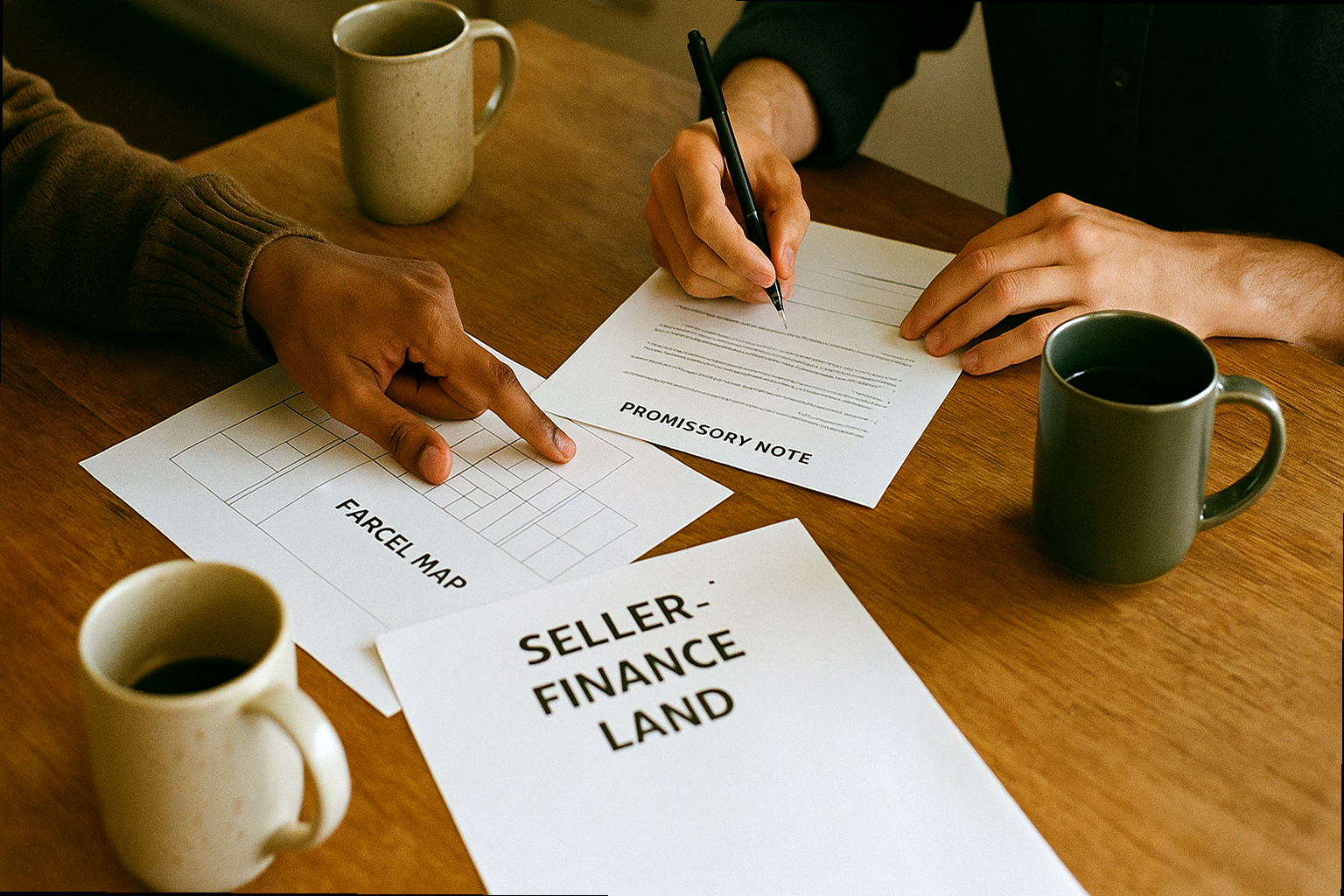
Some owner-finance deals are documented with a purchase agreement, promissory note, and deed of trust or mortgage-style security instrument. Others use a contract-for-deed or land-contract structure where title transfer happens later.
The structure changes the buyer's protections.
That is not just theory. The Consumer Financial Protection Bureau says contracts for deed, also called land contracts or installment land contracts, have historically created serious risks for buyers when documentation, title, or default rules are weak.
For LandShop readers, the lesson is simple: do not treat all owner-financing as interchangeable. Ask exactly what documents are being used and when title changes hands.
Why buyers like it
Owner financing can be attractive because:
- the seller may be more flexible than a bank,
- the land may be financeable even if a lender says no,
- the process can move faster,
- and the buyer may be able to start smaller and improve the parcel over time.
That is why it remains one of the most useful paths for rural land access. It can be a real tool for ownership when the terms are fair and transparent.
What you need to verify before signing
The most important rule is this: never judge an owner-finance deal only by the monthly payment.
Check:
- Down payment
- Interest rate and amortization
- Balloon payment or early payoff rules
- Late fees and default provisions
- Title status and who holds title during the term
- Taxes, insurance, and maintenance responsibility
- Whether the land itself passes due diligence
CFPB's 2024 contract-for-deed report highlights why this matters. Weak title documentation, poor disclosures, and harsh default terms can leave buyers with far less protection than they expect.
Good owner financing should create clarity, not confusion
There is nothing wrong with seller financing when it is used honestly. In fact, it can create access where conventional lending is too rigid.
But a good owner-finance deal should make the land clearer, not murkier.
That means:
- the seller can prove title,
- the payment terms are written cleanly,
- the default path is understood,
- and the buyer has enough information to decide whether the parcel still makes sense long term.
This is where the owner financing guide and owner financing FAQ should be treated as starting points, not optional reading.
When to walk away
Walk away if:
- the seller will not explain the documents,
- title is unclear,
- the parcel still has unresolved access or use problems,
- the payment looks affordable only because a balloon problem is hiding later,
- or the contract is so weak that you cannot clearly describe what happens if either side defaults.
Land is already specific. The financing should reduce uncertainty, not add more of it.
Practical takeaway
Owner financing can be one of the best ways to enter land ownership, especially on parcels that banks do not love. But it only works in your favor if the structure is strong and the land itself is still worth owning.
Want help reviewing owner-finance terms or comparing a seller-financed parcel against other options? Sign up for LandShop and ask questions in the community. You can get practical feedback before you sign.
Sources and further reading
FAQ
Is owner financing the same as a land contract?
Not always. Seller financing can be documented in different ways, and those structures can give buyers very different levels of protection.
What is the biggest risk in an owner-finance land deal?
The biggest risk is assuming the monthly payment tells the whole story. Title, default rules, balloon payments, and taxes matter just as much.
Can owner financing be a legitimate path into land ownership?
Yes. It can be one of the most practical land-access tools when the documents are clear, the title is clean, and the parcel still passes full due diligence.
More questions in this topic
Related links
Ask LandShop
Need help applying this to a real parcel?
Bring your actual land, financing, tax, zoning, or build question into the LandShop community and pressure-test the plan before you commit.