How to Build a Tiny Cabin Property in Phases
Answer-first summary
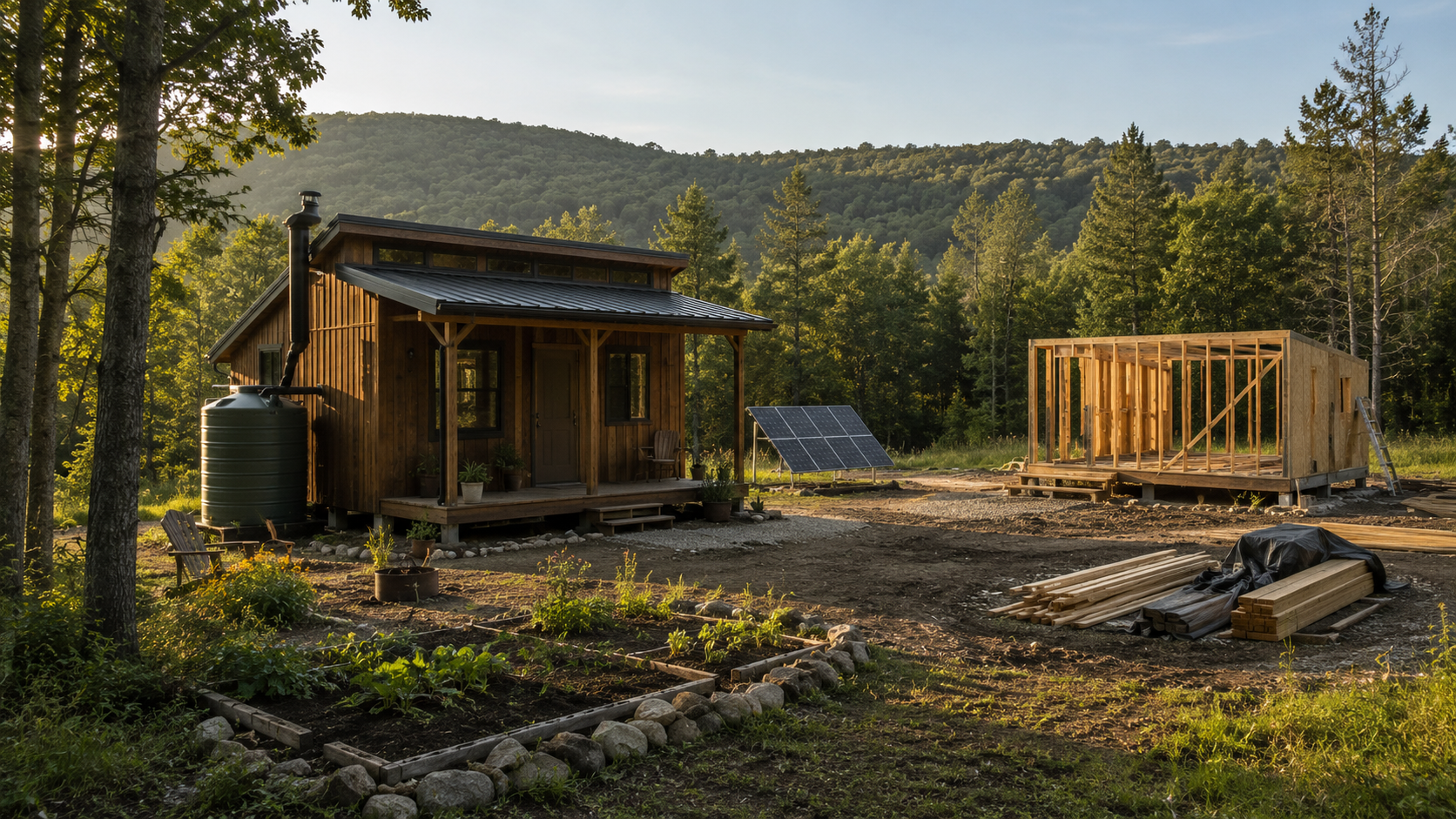
A phased tiny-cabin property works when the first unit is treated as a legal, financeable, serviceable project, not as the first piece of an unapproved fantasy village. The land has to support the use, the zoning has to tolerate the operating model, and water, septic, access, and permit logic have to keep working as more units are added. In practice, the clean path is to start with one strong unit, learn the site, and let real demand justify the next build.
Start with one legal unit, not a fantasy village
The most useful lesson in phased cabin development is not “build a bunch of cabins.”
It is “make the first unit real.”
That means the first cabin should stand on a parcel that actually supports the intended use, can be permitted the way you are describing it, and has a believable path for access, wastewater, water, and power. If unit one only works because the county has not noticed it yet, you do not have phase one. You have delayed failure.
That is why this model fits LandShop’s broader rule: ownership first, clarity first, expansion second.
The land decides what kind of project this can become
People often talk about cabin villages as if design is the first question.
Usually it is not.
The first questions are:
- is this parcel residential, commercial, agricultural, or some mixed local category,
- does the jurisdiction treat multiple short-stay units as lodging, campground use, or something else,
- and what density or structure count is actually allowed?
Those answers shape the entire project.
On some parcels, one cabin plus one accessory structure may be straightforward. On others, multiple rental units may push the property into a campsite, hospitality, or other commercial-use framework. The label varies locally, but the practical point is the same: multiple units usually change the approval path.
What this can allow, and what it does not
When a parcel and jurisdiction line up well, a phased tiny-cabin project can allow:
- one strong first rental or retreat unit,
- later expansion into additional small units,
- a clearer case for operating income,
- and a more financeable path once the site has a history of legal use and real demand.
What it does not allow is pretending that several stay units on one parcel are still just a normal single-house project because the structures are small.
Size does not erase land-use intensity.
That is one reason mixed-use and nonstandard-use underwriting gets harder as the property’s business function becomes more central. Fannie Mae’s mixed-use appraisal guidance is a reminder that once a parcel stops looking primarily residential, the financing conversation changes with it.
Build the utility plan before you build the second cabin
The glamour part of these projects is the unit design.
The project-killing part is usually the infrastructure.
Before adding more units, buyers should know:
- whether the well can support the added demand,
- whether each cabin needs its own septic approach or whether the site can support a coherent shared design,
- how access and parking will work without turning the parcel into mud and conflict,
- and how electric service, drainage, and maintenance scale with each added structure.
The Environmental Protection Agency’s guidance for rental properties with septic systems is useful here because the core problem is predictable: more guests and heavier use can overload a system that looked fine on paper.
That is why How to Think About Water, Septic, and Driveway Costs Before You Buy belongs right in the middle of this conversation.
The first unit should teach you whether the second one is earned
Phased development makes sense when capital is limited, but only if the first cabin is treated as a test of the land and the operating model.
That first unit should answer real questions:
- does the site book,
- does access hold up in real weather,
- do guests understand the location,
- does the utility setup perform,
- and does the county remain comfortable with what is actually happening on the parcel?
If the answer is yes, then the next unit becomes a business decision grounded in evidence rather than a guess grounded in optimism.
That sequence is much healthier than trying to finance or self-build five units before the land has proven anything.
Permits and legitimacy are part of the asset
People sometimes treat permitting as a bureaucratic obstacle instead of part of the value.
That is backwards.
The permit trail, inspections, legal use path, and certificate logic are part of what makes the finished property durable. They matter for safety, but they also matter for refinance, resale, insurance, and valuation.
If you eventually want the property to function as a serious asset instead of a fragile side project, legitimacy is not optional.
Practical takeaway
The smartest way to build a tiny-cabin property in phases is to make phase one fully real:
- the right parcel,
- the right local use path,
- the right utility plan,
- and a first unit that proves the land can actually carry the model.
Then expand only after the site earns expansion.
Related questions
- How to Buy Raw Land for a Homestead
- How to Think About Water, Septic, and Driveway Costs Before You Buy
- How to Buy Land in Phases Without Overcommitting
- Land Business Hub
Want help pressure-testing whether a parcel can support phased cabins, stays, or a mixed-use land plan? Ask LandShop.
Sources and further reading
FAQ
Can you build multiple tiny cabins on one parcel?
Sometimes, but the answer depends on local zoning, lodging rules, utility capacity, and whether the parcel is being treated as residential, campground-style, or commercial use.
What should come before the second cabin?
The first cabin should prove the site works: permitting, access, septic, water, power, guest demand, and county comfort with the actual use.
Why does phased cabin development make sense?
Because it lets buyers start with one legal, useful unit, learn the parcel, and let income or demand justify expansion instead of overbuilding too early.
Do small cabins avoid zoning and permit issues just because they are small?
No. Small structures can still trigger major use and density questions, especially when several units are being rented on one parcel.
More questions in this topic
Related links
Ask LandShop
Need help applying this to a real parcel?
Bring your actual land, financing, tax, zoning, or build question into the LandShop community and pressure-test the plan before you commit.